Skip to the questions

Reader-run reference on Whalebuy. Not Whalebuy's website, and not connected to the company that runs it.

SpreadsheetQuestion Map

Putting an order right, and the windows that close

Four published windows and a long exclusion list. Almost every unhappy ending on this service comes from a clock nobody mentioned at the time.

Fixing

A hundred and twenty hours, counted carefully

The swap and send-back service is described as a seller-side guarantee that the agent administers. The window runs five days from the stored state, and the page spells out that five days are a hundred and twenty hours, and the count opens at the next full hour once the status flips. Miss it and the page says the request may not be accepted.

There is a published list of what the service does not cover, and it is long: made-to-order goods, anything whose packaging, tags or accessories you asked to have removed, newspapers and periodicals, anything bought second-hand, anything sourced outside mainland China, hosiery and underwear, adult goods, food, book orders of fifteen copies or more, and sealed goods that would have to meet a special repacking standard. Where a request is accepted, return postage inside China is yours, and on goods the seller did not ship free you carry both legs.

How long does a swap take?

Posted rule

The after-sales page puts a straightforward return at roughly seven to fifteen days once the seller agrees, and a swap at seven to twenty, because a swap involves two domestic journeys and the seller's own pace. It advises keeping swaps to a minimum if time is short.

Read on Whalebuy's How to apply for aftersales? page, 21 and 22 October 2026.

In practice

A swap pushes an order into a second month. On anything seasonal, a refund and a fresh order is usually faster than waiting for the original seller.

Misread as

Buyers read the window as a right of return. It is a request passed to the seller, and the page says approval cannot be guaranteed.

Fixing

Cancelling and refunding, by where the order has got to

The paths differ sharply depending on how far the order has travelled, and the published timings are worth knowing before you ask.

  • Waiting to be processed. Cancel from the order view; the money returns to the account balance immediately.
  • Being processed. Cancel from the order view; if nothing has been bought yet the refund lands in the balance inside a working day.
  • Already purchased. Raise it on the order; the agent asks the seller. If the seller has not dispatched, the page puts the refund at about three days from the seller's confirmation.
  • Seller says it is sent but it is not moving. Same route, with a published figure of about seven days once the seller confirms.
  • Stored, inside the window. A return or a swap, at the timings above.

The service standards add two commitments on the agent's side: an order is to be bought within a day of your confirmation or top-up, a cancellation in the processing state is handled within a day, and a cancellation after purchase is checked with the seller within two days.

I only noticed the fault after I unpacked it at home.

Posted rule

There is a path, with conditions. The page asks for photographs of damage, of a size label where sizing is disputed, of the item as a whole where the wrong style turned up, and of the parcel beside its contents where something is missing. It also sets a seventy-two hour limit for raising shortages, damage or defects after receipt, and lists exclusions including opened sealed media, replaced or incomplete goods, and anything without the original purchase record.

Read on Whalebuy's What do I do if there is a product issue after I received it? page, 21 and 22 October 2026.

In practice

Photograph before you unpack properly, and weigh the parcel first if the weight looks wrong. The evidence the page asks for is almost impossible to produce once the box is in the recycling.

Misread as

People spend a week deciding whether to complain. The published window is three days, and the clock runs from delivery rather than from when you opened it.

Fixing

Cover you buy, and cover you do not

Three covers are offered at the point you submit a parcel: delay, customs hold, and loss or damage. The delay cover is the only one with a published formula, paying a fifth of the shipping cost when delivery runs past a route-dependent threshold of thirty or forty days from dispatch. Whether a given destination can buy cover at all is answered by the estimator rather than by the policy page.

Without cover there is still a compensation standard per route, claimed through support. The exclusions on both sides are where the detail lives: delays caused by weather, war, epidemics, a customs inspection, or a recipient who did not collect are outside the delay cover; losses caused by a recipient's own failure to sign are outside the loss cover; and a customs hold caused by refusing to cooperate with clearance is outside the customs cover. Fragile goods are named as eligible for loss claims but not damage claims, whether or not the packing was reinforced.

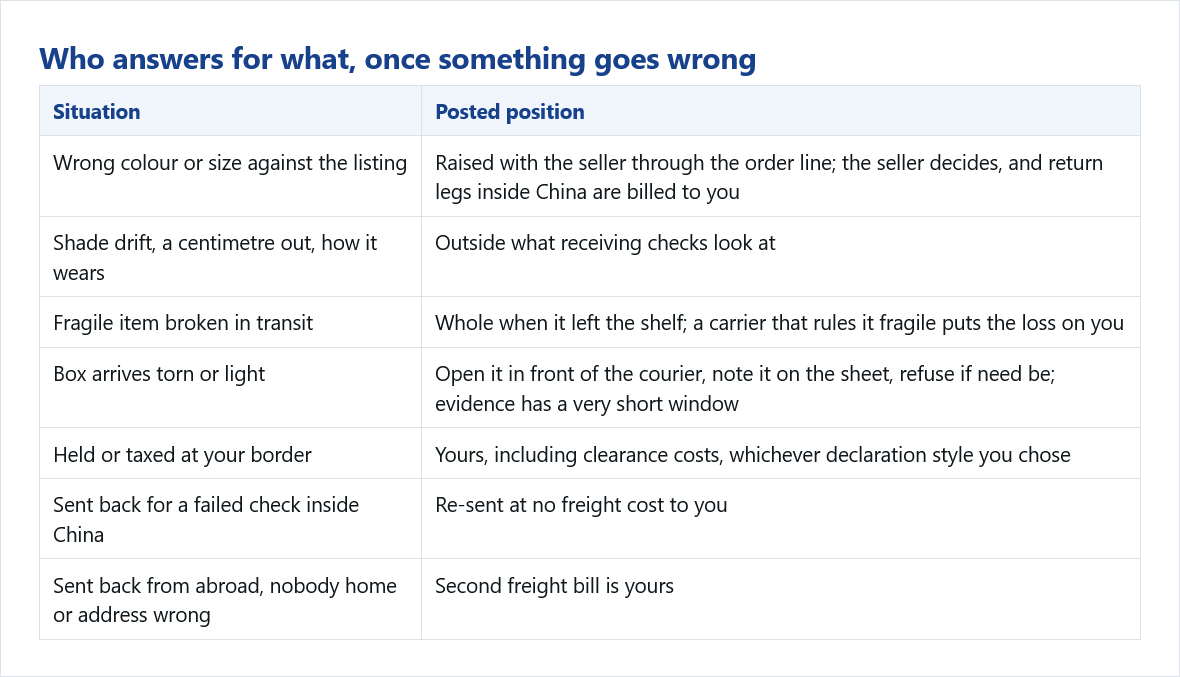
A table of situations and the company's published position on who carries each one
Who answers for what, assembled from the receiving, insurance and customs pages.

My parcel came back. Who pays to send it again?

Posted rule

It depends which border turned it around. A parcel refused by a domestic security check inside China is re-sent at no freight cost to you. One that went abroad and came back for a failed check, an unknown address, an undelivered attempt or nobody signing leaves the cost of re-sending with you.

Read on Whalebuy's What is a foreign return package? page, 21 and 22 October 2026.

In practice

The expensive failures are address failures. Check the address on the submission screen every time, because that is the one the carrier gets.

Misread as

Both kinds of return look identical in the account, so the free one and the costly one get treated the same. They are different events with different bills.

Next: the words all of this is written in.