Skip to the questions

Reader-run reference on Whalebuy. Not Whalebuy's website, and not connected to the company that runs it.

SpreadsheetQuestion Map

Routes, billable weight and the customs line

A route list is filtered by what is in the box. After that, two weights compete, and a customs line you fill in yourself decides how the parcel is treated at the other end.

Sending

Why your route list looks the way it does

Routes are filtered by what is in the box. Staff set mailing restrictions against goods when they are received, and the submission screen only offers lines that will carry all of it. If nothing is offered at all, the published advice is to open the reason note on the route you wanted and talk to support, who may be able to relax a restriction if you accept the risk that comes with it.

Three kinds of carrier are named: postal services, international express, and dedicated small packet lines. They weigh differently, which is the subject of the next section, and they clear customs differently, which is the subject of the one after that.

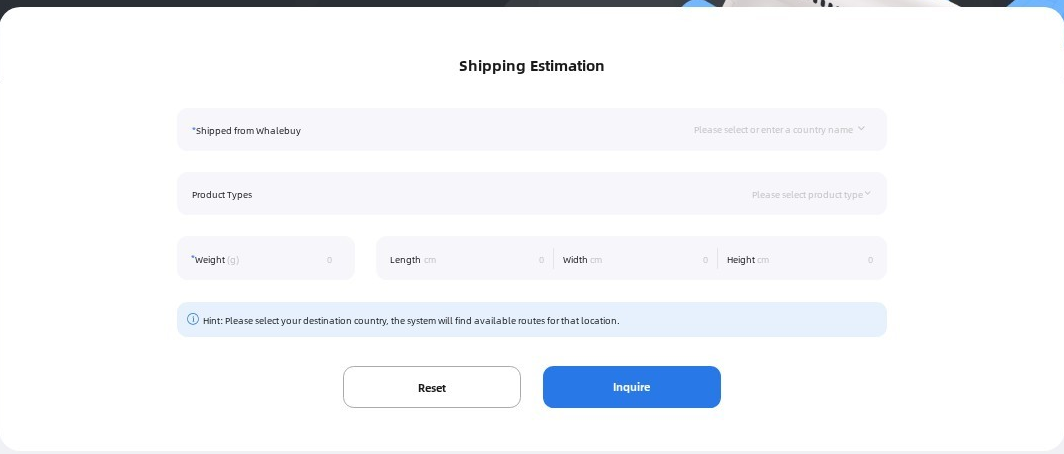
Official shipping estimation form with destination, product type, weight and three dimension boxes above an inquire button
The public estimator, captured 21 October 2026. No account is needed to use it.

How close is the estimator to the final bill?

Posted rule

Whalebuy's own weight page tells you to use the estimate to find out whether volume will be charged, and adds that the estimated billing weight and cost are subject to what the warehouse produces when the parcel is actually packed.

Read on Whalebuy's Actual weight and volumetric weight page, 21 and 22 October 2026.

In practice

Use it to rank routes, not to budget. Feed it a realistic packed weight and real dimensions and the ranking is usually right even when the figure is not.

Misread as

A sounding taken with a guessed weight and no dimensions gets saved as a quote. Leave the dimension boxes empty and the cheapest line on the list is often the one that will move most once a real box is measured.
Sending

Two weights, and the one that wins

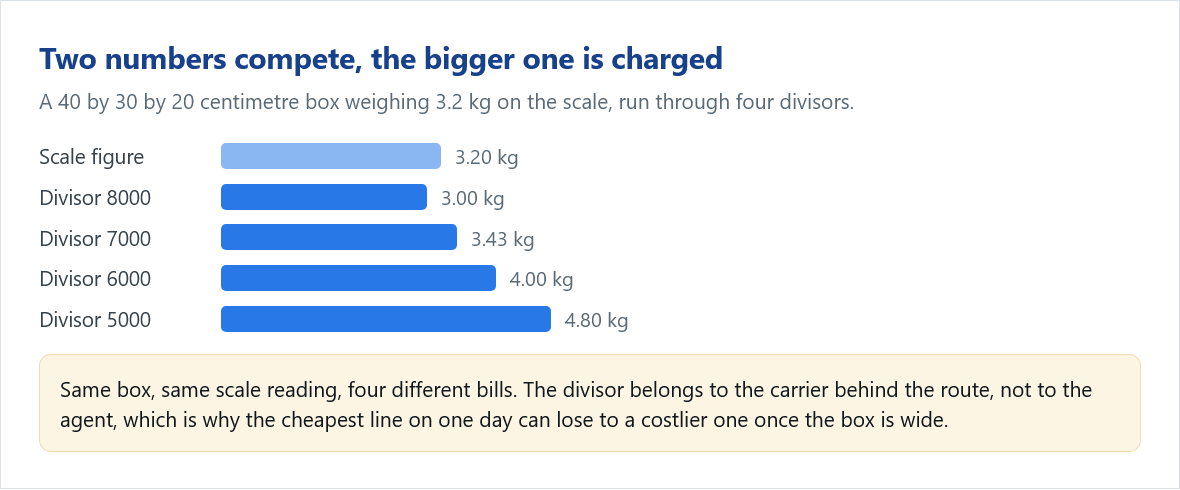
Lines that care about volume generate two figures when a parcel is submitted and charge on the larger. One is the scale reading of the goods plus their packing. The other is derived from the box: the three sides multiplied together and divided by a number that belongs to the carrier. Whalebuy's page gives five thousand as the usual divisor and names six, seven and eight thousand as alternatives used by different logistics providers.

That divisor is the whole game on anything bulky. The same box can be billed at three kilos on one line and nearly five on another without a single gram changing.

Bar chart comparing a 3.2 kilo scale reading with volume figures at divisors of 8000, 7000, 6000 and 5000
One box, four divisors. The bar that matters is whichever is longest on the route you pick.

I was charged on an estimate. What if the real box weighs less?

Posted rule

There is a published reconciliation. If the actual billing weight comes out above the estimate you are asked to make up the difference; if the estimate was higher by more than the step range, the system is said to refund the gap to the account balance within seventy-two hours of dispatch. The final figure can be checked on the parcel detail about three days after it leaves.

Read on Whalebuy's Estimated billing weight versus actual billing weight page, 21 and 22 October 2026.

In practice

Check the parcel detail a few days after dispatch rather than at the moment of payment. A small refund landing in the balance a week later is the normal shape of this.

Misread as

The top-up request looks like a second charge for the same thing. It is the gap between a weight estimated from stored goods and a weight measured on a packed box.

Sending

Filling in the customs line

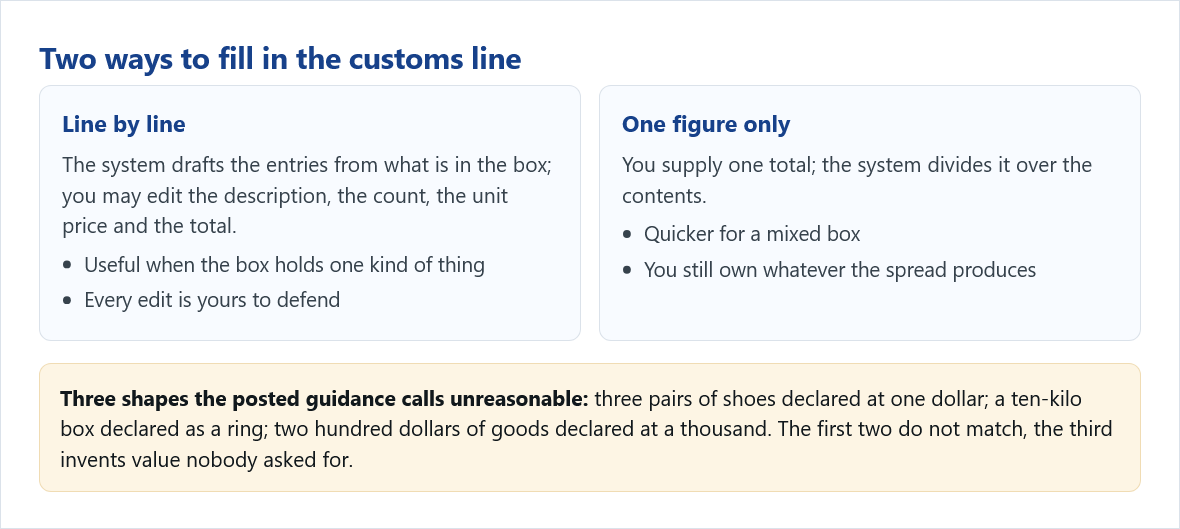
Two styles are offered. In the first, the system drafts entries from the contents and you may edit description, count, unit price and total. In the second you supply one total and the system spreads it. The published guidance is blunt about what will not survive inspection, and gives three worked examples of declarations that do not match their goods.

Two cards comparing line-by-line declaration with a single-figure declaration, above a note listing three unreasonable declarations
The two styles and the three shapes the published guidance calls unreasonable.

At what value does my country start charging tax?

Posted rule

Whalebuy publishes a reference table of thresholds: eight hundred dollars for the United States, a thousand Australian dollars for Australia, a thousand euro for Russia, three hundred dollars each for Singapore and New Zealand, a hundred and thirty for Japan, twenty Canadian dollars for Canada, a hundred Swiss francs for Switzerland with a lower sales-tax threshold beneath it, and zero for both the United Kingdom and the European Union. The page labels all of it as collected reference material rather than official guidance.

Read on Whalebuy's Reference for tariff threshold points in various countries page, 21 and 22 October 2026.

In practice

For British and European addresses there is no free allowance to aim at, which makes the sales-tax arrangements on some routes the thing to compare instead of the declaration figure.

Misread as

An old twenty-two euro or fifteen pound allowance still circulates in forums. Both were abolished years ago and the company's own page says so.

Some routes offer to pay European sales tax for me. What is the catch?

Posted rule

The tax reform page says the platform offers that arrangement on some routes, calculating tax from fixed national rates and your declared amount. Three conditions are attached: the declared total cannot be edited after submission, the minimum declarable amount is limited to thirty per cent of the contents' value, and the platform will not disclose the identifier it uses.

Read on Whalebuy's Explanation on Tax Reform in the UK and EU Countries page, 21 and 22 October 2026.

In practice

It buys speed and paperwork rather than immunity. The same page says it does not guarantee against being taxed again at the border, and tells you to clear and then claim the prepaid amount back with the receipt.

Misread as

Prepaid tax is read as a guarantee of a clean delivery. The page explicitly declines to promise that.

Sending

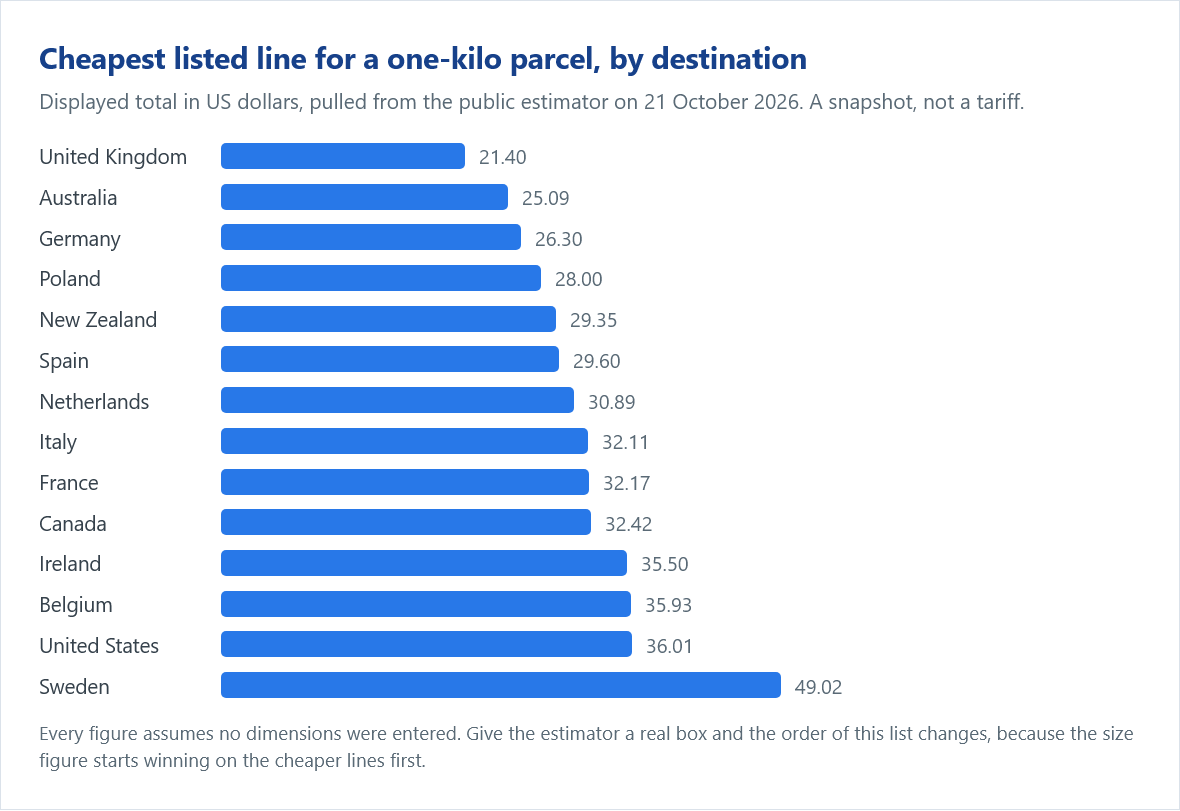
What a kilo cost on the day we looked

The public estimator was exercised across fourteen destinations in October with a one-kilo parcel and no dimensions entered. The cheapest listed line ranged from a little over twenty dollars to a little under fifty. These are soundings on one day, with no box measured and no voucher applied, and they will have moved by the time you read them.

Horizontal bar chart of the cheapest listed one-kilo line for fourteen destinations, from the United Kingdom at the top to Sweden at the bottom
Cheapest listed line for a one-kilo parcel, displayed total in dollars, read 21 October 2026. Enter real dimensions and this order changes.

Two things the raw route lists show that the summary does not. Several lines carry a daily capacity and simply refuse a parcel once it is used up, with a note saying capacity returns at midday China time. And lines are labelled for how tax is handled, some arriving with duties settled and others leaving them to the person at the door. Both of those matter more than a few dollars of headline difference.

The parcel shipped days ago and tracking is still empty.

Posted rule

The published explanation separates two silences. Some routes do not produce a first scan until roughly three days after dispatch. After that first scan, the next update can take another three to ten days depending on the route, and the company says a note appears under parcels on the slower lines.

Read on Whalebuy's Why has the trajectory not been updated since the package was sent out? page, 21 and 22 October 2026.

In practice

Silence in the first week is normal on economy lines and not evidence of a problem. If you need visible movement, that is an argument for an express line rather than for chasing support.

Misread as

An empty tracking page gets read as a lost parcel, and support gets a message on day two. The posted expectation is that nothing will be visible yet.

Next: the windows for putting something right.