Skip to the questions

Reader-run reference on Whalebuy. Not Whalebuy's website, and not connected to the company that runs it.

SpreadsheetQuestion Map

Three warehouse frames, and where their reach stops

Front, back, and one side or label. The published scope is narrower than most buyers assume, and knowing where it stops is what makes the frames useful.

Photographing

What arrives for nothing

Ordinary receiving photography is described as generally three frames: front, back, and one side or the label. They are normal-resolution pictures taken to record the goods, not studio work. Paid detail shots are a separate thing, bought per frame, and a fine-photography service exists for buyers who want specific angles or measurements laid against a tape.

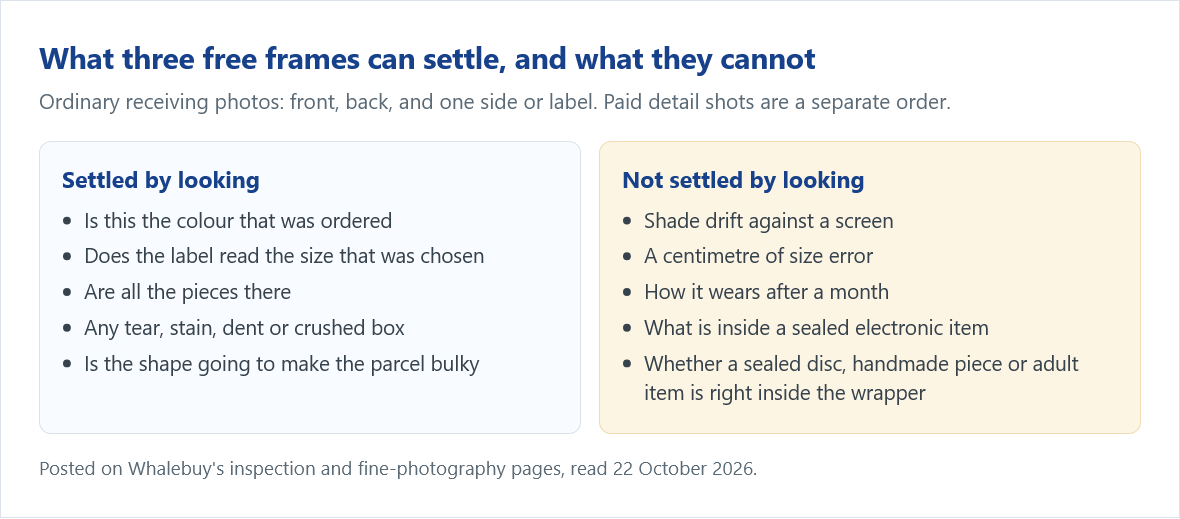
The checking that goes with those frames has a published scope. Quantity, colour, size and similar specifications are verified against the order. Shade drift, size error and how something performs in use are named as outside it. Electronics and digital goods are examined from the outside only. Nothing gets switched on, and a sealed accessory set is not opened to count it. Sealed media, handmade goods and adult goods are checked for external damage and not unsealed at all.

Two columns listing what the free frames can settle and what they cannot
The published scope of receiving checks, split into what a photograph can answer and what it cannot.

How many photographs will I get?

Posted rule

Three, as a rule. The fine-photography page describes the standard inspection set as generally three ordinary pictures: the face of the item, its reverse, and one side or a logo, and it them with high-definition shots taken to a customer's stated requirements.

Read on Whalebuy's Introduction to Fine Photography page, 21 and 22 October 2026.

In practice

Three frames settle colour, count, label and obvious damage. If your decision rests on a seam, a stitch count or a measurement, buy the extra frames rather than squinting.

Misread as

Three is read as a promise rather than a norm. The word on the page is generally, and the count is not contractual.

Photographing

Reading the frames you are given

Here is how to read the QC photographs you are given, starting with the company's own checklist, which is a good one. Compare the item against the variation you chose, not against the listing's hero photograph. Check that a visible size, model or specification label matches. Count what arrived. Look for stains, tears, cracks, dents and missing pieces, and look at the packaging as well as the goods.

Then look at the frames as a freight problem, which is the part most buyers skip. Does this thing look bulky for its weight. Would the retail box push it over a volume threshold. Is there anything in there with a battery, a liquid, a powder or a pressurised can in it, because that shortens your route list later.

Can the photographs tell me whether something is genuine?

Posted rule

The company's own answer is no. Its explainer says ordinary warehouse images show visible detail but do not amount to authentication, and the receiving pages add that identifying genuine, imitation or intellectual-property-infringing goods is outside what the warehouse does. A separate published policy prohibits non-authentic goods outright and reserves the right to refuse orders, suspend accounts and hold funds.

Read on Whalebuy's How Whalebuy QC Photos and Warehouse Inspection Work page, 21 and 22 October 2026.

In practice

A photograph answers did I get the thing I ordered. It does not answer is this thing what the seller says it is. Those are different questions and only the first one is in scope here.

Misread as

Clear photographs get read as a verdict on the goods. They are a record of what was in the box on the day it was opened, nothing more.

The photographs look wrong. What do I do first?

Posted rule

Whalebuy's explainer says not to submit the item for international shipping until the problem is understood, to compare the warehouse record against the variation you chose and the seller's listing, and to contact support through the order record naming the relevant photo.

Read on Whalebuy's How Whalebuy QC Photos and Warehouse Inspection Work page, 21 and 22 October 2026.

In practice

Stop the parcel first and argue second. Settling a problem before the goods leave China is faster and cheaper than any return from abroad, and your swap window is already running.

Misread as

People ship first and complain later, on the theory that they will see it better in person. That moves a cheap domestic problem onto an expensive international one.

Photographing

Odds and ends the photographs turn up

Sellers add things. The published rule on freebies is that anything the seller includes is yours regardless of value, and it goes in the parcel unless you asked otherwise or it cannot be mailed. The rule has a sharp edge: if you did not mention a specific gift in your order notes and the seller did not send one, nothing is reissued, and gifts are not inspected or covered by after-sales at all.

The other recurring surprise is what a seller's option menu actually contains. Published menus on these marketplaces routinely mix unrelated goods, resale tags, packaging add-ons and made-to-order variants into one list, which is why the walkthrough page insists on reading the seller's own text rather than the option name.

Next: routes, weights and the customs line.